Exotic Penthouse Suites USA: A Strategic Asset Audit
The modern American penthouse exists at the intersection of extreme architectural ambition and rigorous mechanical precision. To inhabit such a space is to engage with a complex, swaying structure that functions as a high-performance vessel. It is rarely just a residence; instead, it serves as a critical infrastructure node. While the allure of the panoramic view remains a powerful market driver, the enduring value of these assets resides not in the vista itself, but in the structural and mechanical stability of the environment that captures it. An exceptional residence without a stable, high-functioning envelope is merely a glass-walled exposure, vulnerable to the very elements it seeks to showcase.
For the investor or the seasoned occupant, the distinction between a prestige unit and a truly functional asset lies in the integration of the residence with the building’s broader systems. Super-tall structures are not static pedestals. They are dynamic systems designed to dissipate massive aerodynamic and seismic forces. Consequently, the high-altitude environment must be calibrated to withstand these oscillations, thermal shifts, and atmospheric pressures. The most successful spaces manage this complexity through sophisticated engineering that remains largely invisible to the occupant. True performance is defined by the seamless nature of this support.
This audit deconstructs the structural, operational, and financial realities of high-altitude residential assets in America. We look past the aesthetic gloss of the skyline to address the underlying systems—the vertical transit logistics, the thermal management, and the envelope durability—that dictate long-term performance. By deconstructing the systemic requirements of these assets, we establish a rigorous framework for identifying, maintaining, and evaluating the environments that define the apex of the residential market.
Understanding “exotic penthouse suites usa”
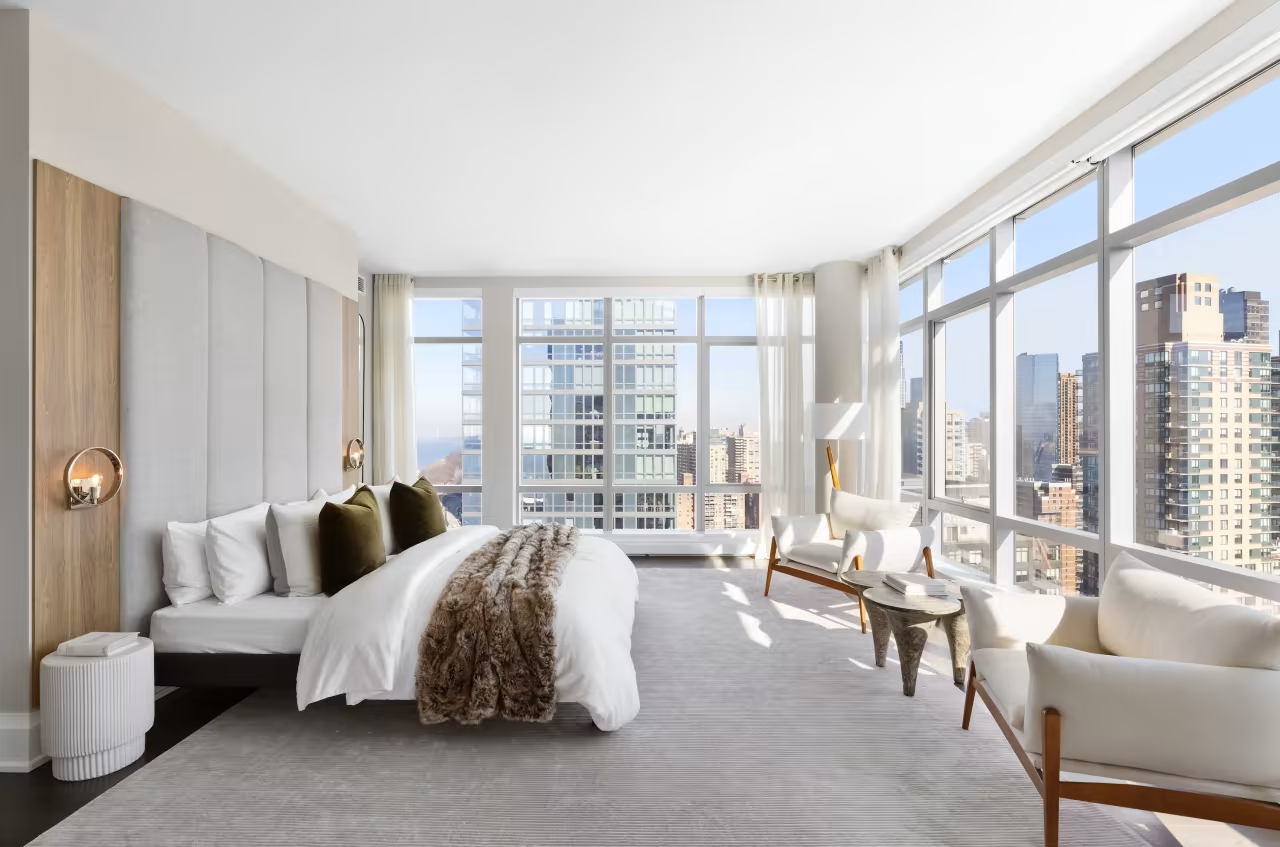
When analysts attempt to identify the exotic penthouse suites usa, they frequently encounter the “Vista-Mechanical Fallacy.” This is the mistaken belief that a superior view compensates for a lack of mechanical infrastructure. In practice, a penthouse with a stunning vista remains a liability if its HVAC system struggles under the load of solar gain or if its envelope leaks during extreme weather events. The most robust assets in this category are those that have successfully addressed the “stack effect”—the vertical air pressure differentials that characterize super-tall structures. Occupants who prioritize the view over the mechanical integrity of the glass and seal systems inevitably face high energy costs, interior degradation, and acoustic instability.
Furthermore, the search for exotic penthouse suites usa is often plagued by a misunderstanding of operational latency. In an eighty-story tower, the physical distance between the street-level lobby and the penthouse is a logistical barrier. If the unit does not possess dedicated, priority-access vertical transit, the occupant loses the primary benefit of high-altitude living: the ability to exist above the friction of the city. Mastery of this asset class requires a diagnostic mindset. One must audit the building’s facility records, verify the maintenance history of the unit’s independent life-support systems, and assess the exclusivity of the transit protocols before committing to the space.
Deep Contextual Background: The Evolution of Vertical Habitats
The vertical residence has historically tracked the rapid densification of the American urban core. Early rooftop structures were largely utilitarian—mechanical housing for boiler exhausts and cooling towers. It was only through the maturation of high-speed elevator technology and load-bearing steel frames that the “pinnacle living” concept became viable. By the mid-20th century, the penthouse emerged as the most significant financial and social anchor of the skyscraper.
This evolution necessitated a parallel advancement in engineering. Modern towers represent dynamic, swaying assemblies that must dissipate massive aerodynamic forces while maintaining the comfort of the occupant. This systemic shift moved the burden of cost from the architectural design to the engineering management phase. Today’s top-tier residences are data-rich, sensor-heavy environments. Every system—from the automated sun-shading to the structural dampeners—is managed by a central digital brain. Understanding this transition is essential for any professional tasked with auditing the exotic penthouse suites usa, as it moves the focus from aesthetic markers to the mechanical reliability of the environment.
Conceptual Frameworks for Asset Evaluation
To evaluate the performance of these assets, we employ three specific mental models:
-
The Operational Decoupling Model: Identify how much of the penthouse’s functionality depends on common systems. High-performance units possess localized redundancies—such as independent climate loops, secondary power supplies, and private water filtration—that insulate the occupant from building-wide maintenance cycles.
-
The Circulation-Efficiency Index: In elite residential units, internal circulation is often a source of wasted capital and security risk. We evaluate plans based on their “Livable-to-Transit” ratio, ensuring that the footprint prioritizes functional activity over inefficient vestibules and service passages.
-
The Structural Load-Resilience Framework: A high-altitude residence is an active landscape. We evaluate the asset based on its capacity to support weight—not just of people, but of mature plantings, expansive water features, and the high-grade materials necessary for sophisticated interior finishes.
Key Categories and Operational Variations
| Category | Typical Operational Risk | Primary Asset Utility |
| The Full-Floor Pavilion | Complex site-security management | Maximum privacy and site control |
| The Vertical Duplex | Service-bridge access vulnerabilities | Separation of public and private spheres |
| The Terrace-First Estate | Extreme seasonal façade exposure | Biophilic integration/Dynamic usage |
| The Crowned Super-Tall | Digital/BMS system vulnerability | Iconic status and panoramic reach |
Decision Logic: When evaluating potential candidates for exotic penthouse suites usa, prioritize the building’s mechanical maintenance record. An operator with a transparent, digitized audit log of their facility management provides significantly more value than a high-prestige address with obfuscated logs.
Detailed Real-World Scenarios
-
The Atmospheric Pressure Challenge: At high elevations, the stack effect causes temperature fluctuations. Decision: Utilize an independent, air-gapped climate management system for the penthouse, ensuring that the occupant retains control regardless of the building’s digital state. Failure to isolate this system leads to permanent comfort issues.
-
The Vertical Logistics Constraint: A primary elevator bank fails, threatening the arrival of guests. Decision: A high-resiliency unit must feature a dedicated service lift that bypasses the main bank. This ensures that the host’s timeline remains unimpeded, avoiding the labor premiums associated with logistical delays.
Planning, Cost, and Resource Dynamics
The economic profile of these assets involves high upfront capital requirements and significant recurring operational expenditures. The “Complexity Premium” of managing a residence at height is where value-conscious planning becomes essential.
| Cost Component | Relative Impact | Variability |
| Facility Management (MEP) | 30% | Fixed |
| Logistical Service Fees | 35% | High |
| Security/Insurance Overlay | 20% | Medium |
| Resilience/Backup Systems | 15% | Very High |
Note: The opportunity cost of under-utilized square footage is a recurring financial drag. Optimizing how space is integrated—or excluding it if it provides no mission-critical utility—is a vital step in evaluating the exotic penthouse suites usa landscape.
The Risk Landscape and Systemic Failure Modes
The landscape of risk in the high-altitude sector is dominated by compounding variables. A single point of failure rarely results in a total loss, but it often triggers a cascade of secondary issues.
-
Environmental Degradation: Constant UV and wind exposure on high-altitude terraces accelerates the aging of materials, including sensors and glass seals. If these are not replaced on a rigid schedule, they become critical vulnerabilities.
-
Digital Fragility: Complex integrated systems become liabilities if they are not modular. Prioritize assets that allow for independent, component-level upgrades rather than total system replacements, which are often logistically impossible at height.
Governance, Maintenance, and Long-Term Adaptation
To effectively audit the exotic penthouse suites usa market, one must adopt a proactive, layered governance model:
-
Quarterly Diagnostic Cycles: Automated, non-destructive testing of HVAC loops, electrical redundancies, and leak-detection arrays.
-
Trigger-Based Audits: Establish clear thresholds for when to decommission a failing system rather than continuously patching it. A rule of thumb is to replace systems if maintenance costs exceed 20% of replacement value within a single cycle.
-
Digital Twin Management: Maintain a comprehensive record of every system layout and repair. Future adaptations rely on precision data, not guesswork.
Measurement, Tracking, and Evaluation
Evaluation should focus on the delta between expected and actual performance:
-
Leading Indicators: Energy consumption per cubic foot, frequency of sensor-based error codes, and service response time for mechanical issues.
-
Lagging Indicators: Total maintenance expenditure relative to industry benchmarks for similar-tier, high-altitude assets.
-
Qualitative Signals: User feedback regarding the “frictionlessness” of the transit from the lobby to the unit, which correlates strongly with the efficiency of the underlying mechanical and logistical systems.
Common Misconceptions and Oversimplifications
-
“High-floor units are inherently better.” Elevation increases structural risk. The most stable units prioritize the building core over the perimeter.
-
“Buildings are static structures.” Super-tall towers are dynamic systems; this movement must be accounted for in the structural integrity of the finishes.
-
“Smart technology equals efficiency.” Without manual override capabilities, over-automation in high-altitude environments is a major risk factor.
-
“The view is the defining feature.” The view is merely a marketing metric. Conversely, mechanical and structural reliability defines an elite residential asset.
Conclusion
Understanding the landscape of exotic penthouse suites usa requires discerning the intersection of architectural ambition and engineering reality. The true apex of residential design exists where technical performance meets human-centric vigilance. By focusing on the structural realities of vertical habitation and rejecting superficial indicators of prestige, one can identify residences that serve as high-performance, resilient assets. The future of this market belongs to those who view the residence not as a trophy, but as a sophisticated, adaptable system that must be managed with the same rigor as an industrial installation. In the final analysis, the value of an apex residential asset lies in its ability to provide a consistent, high-functioning environment regardless of external conditions, proving that even at the highest level, the foundation—mechanical, logistical, and systemic—is everything.