Modern Duplex Lifestyle Destinations USA: A Strategic Operational Audit
The contemporary American residential landscape is currently witnessing a pivot toward architectural configurations that offer the volume of a detached estate within the high-density footprint of a metropolitan core. The duplex—a dwelling spanning two distinct levels linked by a private internal stair—has evolved from a standard urban housing form into a specialized lifestyle asset. It represents a sophisticated attempt to reconcile the desire for spatial separation with the practicalities of vertical living. This architectural model provides a unique cadence to domestic life, segmenting private rest from public interaction in a way that single-level footprints cannot replicate.
However, the assumption that any two-story unit constitutes a successful residence is flawed. The true efficacy of these spaces depends on the internal circulation, the placement of the staircase, and the strategic distribution of light across the different elevations. When a residence lacks thoughtful vertical integration, it often feels fragmented, with the upper and lower levels existing in a state of operational discordance. A truly high-performance duplex must be designed as a cohesive whole, where the vertical connection acts as a deliberate design feature rather than a merely functional requirement.
This analysis provides an exhaustive audit of the high-end residential market, focusing on how these residences serve as platforms for a sophisticated, modern professional existence. We bypass the surface-level marketing of “open floor plans” to deconstruct the technical necessities of vertical architecture. By examining the logistical requirements of temperature control, acoustic stratification, and the spatial ergonomics of multi-level living, we establish a rigorous framework for identifying environments that function as superior, long-term assets. The objective is to provide a reference for those who prioritize spatial integrity, structural intelligence, and the distinct rhythm afforded by the multi-level residential model.
Understanding “modern duplex lifestyle destinations usa”
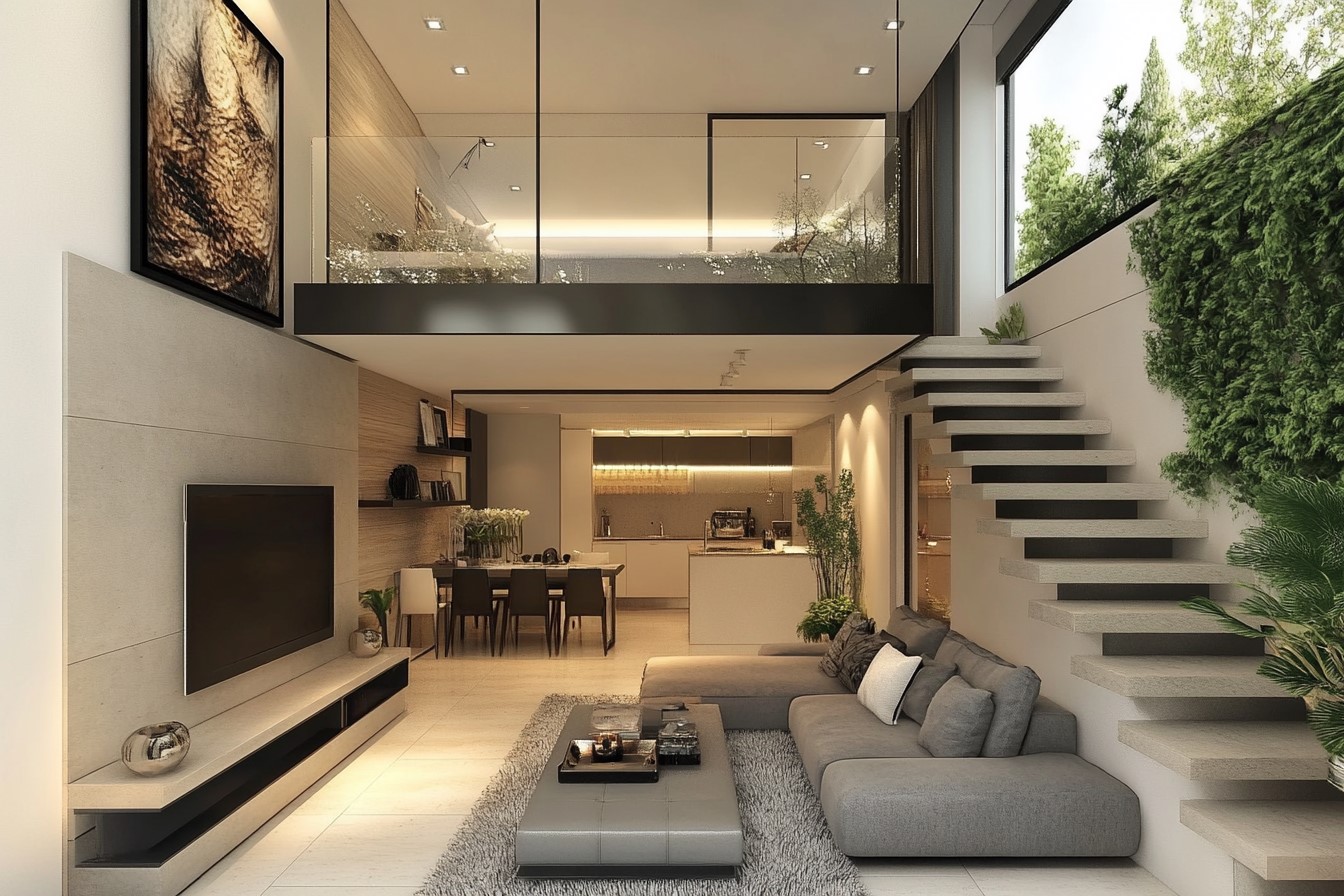
When industry professionals analyze modern duplex lifestyle destinations usa residences, they frequently observe a misunderstanding regarding “spatial volume.” Many buyers incorrectly prioritize square footage over the orientation of the staircase and the resulting flow of natural light. In a duplex, the staircase is the architectural spine of the residence. If it is undersized, poorly positioned, or serves as a claustrophobic conduit, the entire domestic flow is compromised. The most effective residences in this category utilize the staircase as a central organizing element, often integrating it with floor-to-ceiling glass or open-riser systems that pull light through both levels simultaneously.
Another persistent error involves the “Connectivity Assumption.” Investors often assume that two-story units are inherently more private. In reality, unless the building’s HVAC and plumbing systems are specifically engineered for dual-level ventilation and grey-water management, the duplex can suffer from extreme thermal stratification. Heat naturally migrates to the upper level, while the lower level remains cold, leading to significant energy inefficiencies and comfort issues. Identifying the premier modern duplex lifestyle destinations usa offerings requires a diagnostic approach. One must audit the mechanical separation between the floors. A residence that relies on a single, oversized unit to manage the climate for two distinct levels will inevitably experience operational friction. True mastery in this domain involves assessing the building’s ability to support an independent mechanical interface for both floors.
Deep Contextual Background: The Evolution of the Vertical Residence
The development of the duplex in the American urban center was an response to the extreme land-value premiums in the early-to-mid 20th century. As the pressure for residential density increased, architects needed a way to provide the “feel” of a row house within the footprint of a mid-rise or high-rise building. The vertical segmenting of the dwelling became the primary solution. This allowed for a clearer separation of the “social” level (kitchen, living, dining) from the “sanctuary” level (bedrooms, library, workspace).
Over time, this model underwent a refinement process. Developers began to recognize that the duplex could serve as an “urban manor,” offering the same hierarchical organization as a traditional house, but with the added benefits of concierge support and high-rise security. The shift toward the modern era saw these units move from being simple space-saving measures to becoming high-prestige assets. They are now defined by their ability to provide a structured, purposeful domestic environment that mirrors the professional lives of the people who inhabit them.
Conceptual Frameworks for Asset Evaluation
To evaluate the operational quality of these dual-level residences, we utilize three mental models:
-
The Circulation-Efficiency Index: Assess whether the stair placement allows for a direct, unobstructed path between the social and private zones. If the staircase necessitates walking through a utility or circulation bottleneck to reach a bedroom, the residence’s spatial hierarchy is compromised.
-
The Thermal-Stratification Framework: Evaluate if the unit supports independent climate controls for each floor. Without this, the residence will always struggle to maintain comfort, particularly in larger or high-ceilinged spaces.
-
The Acoustic-Isolation Matrix: Determine if the upper level is structurally decoupled from the lower level. Can someone walking on the upper floor be heard distinctly by someone in the kitchen below? The best residences utilize heavy-gauge floor joists and acoustic underlayment to ensure that the vertical levels function as separate zones.
Key Categories and Operational Variations
| Category | Typical Mechanical Risk | Primary Asset Utility |
| The Historic Townhouse Duplex | MEP/Foundation vulnerability | Exceptional heritage provenance |
| The High-Rise Stacked Suite | Vertical service pipe-chase noise | Panoramic view; high-density security |
| The Industrial-Adaptive Loft | Thermal bridging; sound leakage | Expansive volumes; flexible floorplate |
| The Purpose-Built Luxury Unit | High management/HOA oversight | Standardized high-performance MEP |
Decision Logic: When evaluating potential modern duplex lifestyle destinations usa options, prioritize the “Staircase-Light Audit.” If the staircase creates a shadow-well in the center of the unit, the residence will feel disjointed and inherently dark, regardless of its total square footage.
Detailed Real-World Scenarios
-
The Thermal-Control Challenge: A duplex in a cold-climate region relies on a single thermostat located on the lower floor. The upper floor, which contains the master suite, becomes stiflingly hot during the winter. Decision: Install an independent smart-zoning system that modulates dampers within the ductwork for each level. Second-order effect: This drastically reduces the energy demand and improves the quality of the resting environment.
-
The Acoustic-Resonance Issue: A luxury duplex with an open-riser steel staircase creates massive reverberation when someone walks between floors. Decision: Retrofit the stair treads with high-density rubber damping pads and consider the installation of acoustic wall paneling in the main stairwell. This preserves the architectural transparency of the open-riser design while eliminating the sonic friction.
Planning, Cost, and Resource Dynamics
The economic profile of these residences is defined by high maintenance overhead due to the dual-level nature of the mechanical systems.
| Cost Component | Relative Impact | Variability |
| Mechanical System Redundancy | 35% | High |
| Vertical Access/Stair Maintenance | 25% | Medium |
| Acoustic/Environmental Sealing | 20% | High |
| Architectural/Finish Stewardship | 20% | Low |
Note: The modern duplex lifestyle destinations usa residents who manage their assets effectively recognize that the staircase is not just a walkway; it is a structural element that requires regular maintenance to prevent squeaks and wear, which can negatively impact the residence’s resale value.
The Risk Landscape and Systemic Failure Modes
Failure in these environments often relates to the “MEP bottleneck.” As systems age, repairing or replacing vertical water lines, electrical conduits, or climate-control ductwork that runs through two stories of finished space can be significantly more expensive than in a single-level home.
-
The Pipe-Chase Leak: A leak in an upper-level bathroom can damage the ceiling of the lower-level kitchen. The modern duplex lifestyle destinations usa residences that remain viable in the long term are those that include built-in, non-destructive access panels to all vertical service conduits.
-
Environmental Imbalance: The tendency to treat a duplex as a single heating/cooling zone leads to systemic inefficiency. Properties that lack the capacity for zoning are effectively obsolete in the current era of climate-conscious luxury living.
Governance, Maintenance, and Long-Term Adaptation
To effectively manage the complexities of these residences, stewards must adopt a proactive, layered governance model:
-
The Mechanical Decoupling Plan: During any renovation, focus on separating the air-handling systems. This is the single most important action for maintaining long-term habitability and efficiency.
-
Acoustic Hardening: Before moving in, conduct a sound-path audit to identify where the floor-to-floor transmission is weakest. Addressing this at the source—usually the utility conduits—prevents expensive later fixes.
-
Digital Integration: Treat the two floors as separate zones in the home automation system to ensure that lightning, shade controls, and HVAC are responding appropriately to the different exposures and thermal requirements of each elevation.
Measurement, Tracking, and Evaluation
Evaluation should focus on the delta between expected domestic comfort and the reality of living on two levels:
-
Leading Indicators: Thermal consistency across the upper and lower levels; ambient noise levels in the private zones while the social zone is in use; response time of HVAC zoning sensors.
-
Lagging Indicators: Total energy expenditures relative to floor-area; maintenance costs associated with vertical utility repairs; the frequency of acoustic complaints between residents sharing the floors.
-
Qualitative Signals: The ease of movement. A residence that feels like an “effortless house” is a success; a residence where you feel like you are “climbing to a different room” is a failure of spatial design.
Common Misconceptions and Oversimplifications
-
“Two floors equal double the living space.” The staircase often consumes 5-10% of total square footage, which is a structural “tax” on the residence.
-
“Open stairs are always better.” Open stairs sacrifice acoustic privacy, which is the primary value proposition of the duplex configuration.
-
“Zoning is optional.” In a modern residence, independent temperature control for each level is a structural requirement, not a luxury feature.
-
“Standard building MEP is sufficient.” Modern luxury requirements often exceed the capacity of aging vertical infrastructure.
Conclusion
Understanding modern duplex lifestyle destinations usa residences is a diagnostic exercise in vertical architecture. The most exceptional residences are those that have been engineered to function as two separate, yet perfectly harmonized, domestic realms. By focusing on the structural independence of the floors, the acoustic hardening of the floorplate, and the intelligent zoning of the mechanical systems, owners can achieve a domestic rhythm that is superior to the single-level alternative. These assets are not mere containers of space; they are complex, high-performing instruments of domestic life. Ultimately, the value of the duplex is found in its ability to provide a structured, clear separation of one’s life, and when this configuration is mastered, the asset becomes a source of profound, long-term personal stability.